Breast & Body Procedures
Abdominoplasty
Tummy Tuck
Abdominoplasty removes excess skin, tightens the abdominal muscles, and creates a flatter, more defined midsection — often combined with liposuction for a complete contour transformation.
About the Procedure
Abdominoplasty — commonly called a tummy tuck — is a surgical procedure that removes excess skin and tightens the core muscles of the abdomen. It is frequently combined with liposuction to remove excess fat around the waist and flanks, creating a flatter, more contoured midsection.
Patients most often seek abdominoplasty after significant weight loss, pregnancy, or when diet and exercise alone are insufficient to address loose skin and weakened abdominal muscles. It is one of the most transformative and consistently satisfying body contouring procedures Dr. Poppler performs.
Abdominoplasty is also a core component of the Mommy Makeover — often performed alongside breast surgery in a single operation to restore the body after pregnancy and breastfeeding.
Where Are the Scars?
Dr. Poppler makes his incision low on the abdomen, usually just above the pubic area and below the hip bones. He uses his experience to predict how the scar will move as your skin heals and stretches during recovery, positioning it so that it remains hidden under skimpy underwear or swimsuits.
Hip-to-Hip Incision
The primary scar runs low across the lower abdomen. Dr. Poppler carefully plans its position so the final healed scar falls well within the bikini line.
Belly Button Scar
If the belly button is repositioned during surgery — which is common — a small scar forms around it. Dr. Poppler uses a technique that hides this scar inside the natural belly button crease, making it nearly invisible.
Rectus Diastasis
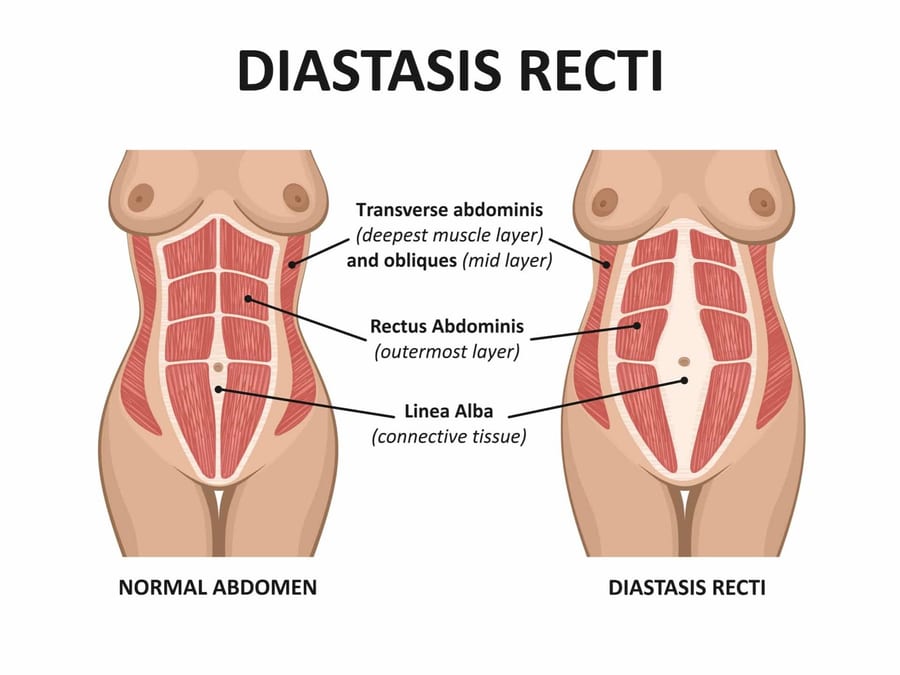
A rectus diastasis is a separation of the six-pack muscles (rectus abdominus) from the midline, most commonly caused by pregnancy. It causes the abdomen to bulge and can make women look pregnant even when they are not. It can also cause core weakness, muscle imbalance, and chronic low back or abdominal pain. Many women are told they cannot do core exercises because they may worsen the condition.
Rectus diastasis is like a hernia of the abdominal wall — but in some ways worse, because it decreases the strength of your core rather than just creating a hole. The fascia (the strong connective tissue that wraps the muscles and holds your organs in place) between the rectus muscles has stretched, thinned, and become much weaker.
How is it repaired?
Through the abdominoplasty incision, Dr. Poppler exposes the abdominal wall from the rib cage to the pelvis, marks the muscle edges, and uses several individual permanent non-braided sutures to bring them back together at the midline. The stretched fascia is folded in on itself — no incisions are made through the abdominal wall, so there is no risk of creating a hernia. This approach creates a strong, durable repair designed to last.
Is it covered by insurance?
Although rectus diastasis can be very debilitating, insurance companies classify it as cosmetic — not a medical condition — so repair is not covered. This is an ongoing form of systemic injustice. If you want to advocate for change, speaking with your state and federal representatives is the most impactful path, and we would be happy to support that effort.
What if I also have a hernia?
Dr. Poppler will examine you carefully for any hernia. Small hernias can be repaired as part of your abdominoplasty at no extra charge. Large or complicated hernias requiring mesh will be referred to a specialist. When a hernia repair is combined with abdominoplasty, insurance may cover a portion of the cost — though the surgery is more complex and takes longer.
Men & Abdominoplasty
Men can also develop rectus diastasis, most commonly from having a large amount of intra-abdominal (visceral) fat — a known risk factor for heart attack, stroke, and peripheral vascular disease. In these cases, significant weight loss is essential before surgery, as operating on a patient with a large amount of visceral fat produces poor results and carries higher risk.
Women
- Muscle tightening and rectus diastasis repair
- Removal of loose, stretch-marked skin
- Hourglass waist shaping with liposuction
- Often combined with breast surgery in a Mommy Makeover
Men
- Straighter, less curved abdominal contour
- Removal of excess fat and loose skin
- Natural masculine appearance preserved — no feminizing curves
- Weight loss typically required before surgery if significant visceral fat is present
Mini Abdominoplasty
A mini-abdominoplasty uses a shorter scar and does not require repositioning the belly button — making it a less invasive option with a somewhat faster recovery. However, it is only appropriate for a specific group of patients.
Good candidates for a mini
- Mild-to-moderate excess skin limited to the lower abdomen
- No significant rectus diastasis
- Near their stable goal weight
- Realistic expectations about a more limited correction
Not suitable for a mini
- Significant loose or excess skin above the belly button
- Rectus diastasis (muscle separation)
- Post-massive-weight-loss patients
- Anyone expecting a full-tummy-tuck result
Why Patients Choose This
A flatter, firmer stomach
Removes the loose, protruding skin that diet and exercise cannot address.
Removal of loose or stretch-marked skin
Eliminates the excess skin that hangs below the waistline after pregnancy or weight loss.
Stronger core muscles
Repairing rectus diastasis restores core strength and alleviates chronic back and abdominal pain.
Improved confidence and fit of clothing
Patients consistently report improved body image and the ability to wear clothing they avoided before surgery.
Should I Lose Weight First?
If you are significantly overweight or have a large amount of intra-abdominal (visceral) fat, you may not be a good candidate for abdominoplasty, and Dr. Poppler may recommend losing weight before surgery to improve your result and reduce risks. Best results are achieved when you are at the weight you intend to stay at. Losing weight before surgery is only helpful if you will maintain that weight. Surgery before planned weight loss produces a suboptimal result because your skin will loosen again afterward. It is best to have surgery when you are at a stable, happy weight.
Recovery
~1 week
Light activities
2–3 weeks
Return to work
~3 weeks
Most exercise
~6 weeks
Full recovery
If rectus diastasis repair is performed as part of your abdominoplasty, you will have lifting and twisting restrictions for 3 months to allow the muscle repair to heal fully before stress is applied. Swelling is typically mostly resolved at 4 weeks but will come and go for about 3 months.
Possible Complications
Like all surgeries, abdominoplasty has risks. They are small but are higher in patients with smoking, poor nutrition, diabetes, auto-immune diseases, or blood-thinning medications. Dr. Poppler will review your risk factors at your consultation and help you modify them where possible. Possible complications from most to least common:
At Treasure Valley Plastic Surgery, your safety is our number one priority, and all surgical prices include an insurance plan to help pay for care related to any complications.
Is It Safe?
Abdominoplasty is generally very safe when performed on appropriate patients by a board-certified plastic surgeon. Like all surgeries, there are risks such as infection, bleeding, fluid build-up, or scarring. Choosing an experienced surgeon like Dr. Poppler, following his advice to modify any risk factors before surgery, and following aftercare instructions lowers these risks and improves results. At Treasure Valley Plastic Surgery, your safety is our number one priority, and all surgical prices include an insurance plan to help pay for care related to any complications.
Treasure Valley Plastic Surgery