Facial Procedures
Facelift
Surgery
Natural, long-lasting facial rejuvenation — addressing sagging cheeks, nasolabial folds, jowls, and neck laxity with a premium deep plane facelift experience in Meridian, Idaho.
About the Procedure
A facelift resuspends the supportive tissues of the midface to soften deep lines around the mouth — nasolabial folds and marionette lines — and fullness along the jaw (the jowls). It can also soften deep lines and wrinkles in the skin, though it does not erase every line.
Facelifts should always be performed by a board-certified plastic surgeon with extensive training in facial aesthetic surgery. A poorly done facelift can distort the face; a well-done facelift enhances and restores your unique features. A facelift does not stop aging, but it can soften signs of aging for many years and can be tailored to your unique needs and desires.
Facelift surgery is often done simultaneously with other procedures such as a neck lift to address sagging of the neck or double chin, facial fat grafting to restore volume, brow lift to lift the brows and upper lids, lip lift to create a more youthful upper lip, and laser skin resurfacing to address skin changes. As we age, the facial bones shrink, the fat of our face shrinks, connective tissue stretches and loosens, and our skin begins to develop fine lines, wrinkles, and pigmentation changes. Best results come when all of these components of facial aging are addressed.
Verify your surgeon
Verify ABPS certification before choosing your facelift surgeon at find.plasticsurgery.org.
What Is the SMAS?
The SMAS (Superficial Muscular Aponeurotic System) is an important layer of tissue in the face and neck composed of the muscles of facial expression and their supportive tissues. As people age, the SMAS stretches and sags, resulting in heavy cheeks, deep nasolabial folds, and jowls.
Why the SMAS matters
Effective facelifts work on the SMAS layer because mobilizing and lifting the SMAS — rather than only tightening the skin — creates results that look more natural and that last longer. You can think of the SMAS as the "support layer" that keeps the face in the right shape. Tightening skin alone produces the stretched, unnatural appearance associated with older facelift techniques.
What Is a Deep Plane Facelift?
A deep plane facelift works on the deepest layers of the face, underneath the SMAS. It is Dr. Poppler's preferred technique for patients with substantial facial aging. However, a deep plane facelift is more technically involved, involves greater risk for complications, takes more time, and is therefore more expensive than other techniques.
In deep plane facelift surgery, Dr. Poppler lifts the skin, fat pads, and muscles together as one unit. Going beneath the SMAS allows him to release the retaining ligaments that prevent movement of the SMAS — making this a potentially more powerful technique than alternate facelifts that do not go into this plane. The deep plane also preserves connections of the skin with the deeper tissues, which decreases facial distortion and the chance of some common complications. This method can give very natural, long-lasting results. It is especially good for people with sagging cheeks, deep folds, or a heavy neck.
Dr. Poppler's Approach
Using the deep plane gives Dr. Poppler the option to place the stretched, redundant tissues of your face in areas that are hollow or need more volume — like a permanent, natural filler. He chooses the point where he places your scars, where he enters the deep plane, and where he places the redundant tissues based on your unique needs. He will ask you to bring in photos of yourself at younger ages so the two of you can compare them side by side with your current photos and make a plan together to restore your unique youthful appearance — without making you look "done" or like a different person.
Not one-size-fits-all
Dr. Poppler does not believe in a one-size-fits-all approach, especially when it comes to something as unique and personal as the face. He will carefully evaluate your face, desires, and surgical and medical history and determine the right technique for you.
Are There Other Types of Facelifts?
Yes — there are many ways to do a facelift, and Dr. Poppler has training, experience, and expertise in all of them. The terminology of facelift surgery can be confusing, and many surgeons make up new terms to seem unique. However, these surgeons are typically performing the same basic steps as other facelift surgeons. Rather than focusing on a technique name, Dr. Poppler recommends an approach based on the problems you want treated — addressing your specific concerns in a way that makes sense and provides the best correction with the least risk and least scarring. There is no single "best" technique.
Traditional Full Facelift
An incision begins within the hair above the ear, passes in front of the upper ear in the natural crease, behind the tragus, and around the earlobe. Can be extended behind the ear and along the hairline for a simultaneous neck lift. Allows either a deep plane facelift or a delta lift.
Delta Lift
Uses the traditional full facelift incision. Rather than going under the SMAS, it tightens the SMAS using sutures placed into that layer from above. More quickly performed than a deep plane with less nerve risk, but carries a slightly higher chance of skin discoloration or poor scarring.
Mini-Facelift / S-Lift
An incision that curves along the front of the ear. Addresses mild to moderate cheek descent, heavy nasolabial folds, and mild jowls — but does not address the neck. Dr. Poppler generally does not prefer this technique because it creates the most noticeable portion of the facelift scar without access to perform a more effective result.
MACS Lift
Uses the mini-facelift scar and places cerclage sutures into the SMAS anchored to the temple. Similar to a thread lift but also allows skin excision. Dr. Poppler uses a variation of this technique for mid-facelifts performed through a brow-lift incision — avoiding a scar in front of the ear entirely.
Short Scar Facelift
Dr. Poppler's Preference (mild–mod aging)Avoids an incision in front of the ear and instead relies on an incision around the earlobe and behind the ear, plus a second incision along the sideburn within the hair. For patients with mild to moderate facial aging, this is Dr. Poppler's preferred technique for face and neck — scars are very discreet. A brow lift can also be performed using these incisions.
Mid-Facelift
Not a single established technique but a term for facelifts that primarily lift the cheeks and correct heavy nasolabial folds. Can be done as part of an extended brow lift or as part of a lower lid lift (lower blepharoplasty).
Lower Facelift
Also a descriptive term rather than a single technique — refers to facelifts that primarily lift the lower face and correct jowls. Dr. Poppler performs a lower facelift as part of a neck lift through an incision made behind the ear.
There are many more techniques and names beyond what is covered here. You are welcome to ask Dr. Poppler questions about other techniques or terms you encounter at your consultation.
Incisions and Scars
The incisions are hidden around the ears and within the hairline. There are many different facelift techniques and they vary primarily by how they try to hide or minimize scarring. A traditional full facelift makes an incision that begins within the hair above the ear, passes in front of the upper ear in the natural crease where the ear and cheek meet, then passes behind the tragus (the nubbin at the front of the ear where the ear meets the cheek), and then passes around the earlobe. The incision can then continue up along the back of the ear and along the hairline of the back of the head if a neck lift is performed at the same time. A neck lift usually also includes a small incision under the chin.
After healing, these scars usually blend in very well and are nearly imperceptible.
Included in your surgical price
Your surgical price at Treasure Valley Plastic Surgery includes silicone scar gel to optimize healing and a complimentary laser scar treatment after surgery to make your scars as discreet as possible.
Alternatives to Facelift Surgery
For patients who are not ready for facelift or neck lift surgery, there are several less involved surgical and non-surgical treatments that can dramatically improve the face, neck, and jawline. These can often delay a facelift until the timing is convenient for you.
Facial Fat Grafting
Select patients with significant hollowness and loss of facial volume benefit from fat transfer to the cheeks, lower lids, temples, and upper lids. This can also be done with carefully selected, conservatively placed fillers. Large amounts of filler are generally not recommended — they can be heavy, migrate, and become very expensive. Fat does not have these limitations and can be done safely and affordably in larger volumes.
Chin Implant or Filler
Patients with a small chin or underbite often benefit from a chin implant, fat transfer, or filler placed at the chin. This can also make the nose appear smaller and nicely harmonizes the face.
Botox / Neuromodulators for Neck Bands
Patients without much excess skin — especially those with platysmal bands (neck bands) — can benefit from Botox or other neurotoxins placed in the platysma to create a more distinct neck and jawline.
Biostimulators, Fillers & Laser
Patients with loose or finely wrinkled skin may benefit from a biostimulator placed beneath the skin (Sculptra or Radiesse), a filler placed just under deep wrinkles (Juvederm), and/or a laser treatment such as the HALO Tribrid to improve skin color, texture, and firmness. A series of SkinTyte BBL treatments can also improve mild to moderate skin laxity.
All of these treatments are available at Treasure Valley Plastic Surgery and Medical Spa. Booking a consultation with Dr. Poppler or one of our highly qualified medspa nurse practitioners and physician assistants is the best way to find out what options work for you and your budget.
Facelift vs. FaceTite / Morpheus8 / Ultherapy
There are many non-surgical skin-tightening treatments available at medspas — FaceTite, Morpheus8, and Ultherapy are common examples. At Treasure Valley Plastic Surgery and Medical Spa we offer SkinTyte, a form of broadband light (BBL) treatment that causes the skin to tighten. SkinTyte can be safely used anywhere on the body including the face and neck.
What skin-tightening devices can do
- Effective for mild excess skin laxity
- Non-surgical option for patients not ready for surgery
- Can delay a facelift for select patients
- SkinTyte available at our medspa — does not cause scarring that complicates future facelifts
What skin-tightening devices cannot do
- Do not address sagging cheeks, deep nasolabial folds, marionette lines, or jowls
- Do not improve texture, pigmentation, or fine lines the way HALO Tribrid does
- Effects typically do not last more than a few years
- Radiofrequency microneedling (Morpheus8) can cause fat loss in the face — making it look older
Our recommendation
We recommend patients invest in a highly effective laser treatment like the HALO Tribrid or Contour TRL that will complement their eventual facelift — rather than trying to replace it with a skin-tightening treatment.
Facelift vs. Threadlift
A threadlift places permanent sutures through the skin and into the SMAS without making any incisions. This technique is minimally effective and carries significant risks including unnatural distortion of the face, facial weakness, asymmetry of facial movements, infection, and scarring that makes a future facelift more dangerous, more difficult, and more expensive.
Dr. Poppler's position
Dr. Poppler and most board-certified plastic surgeons do not offer and do not recommend threadlift given these risks. If you have had a threadlift and are considering a facelift, Dr. Poppler can discuss the implications at your consultation.
Facelift vs. Facial Fat Grafting
Facial fat grafting and facelift complement one another and are often done together. Facial fat grafting replaces fat that is lost as part of natural facial aging. Dr. Poppler has extensive experience with facial fat grafting and considers it one of his favorite procedures because of its excellent results.
Some surgeons perform fat grafting at the time of facelift. Dr. Poppler generally recommends having fat grafting after a facelift — because it affords an opportunity to correct any asymmetries present after facelift, and fat grafting can be done more aggressively and more accurately when you are fully healed. For patients looking to avoid or delay a facelift, fat grafting can be done safely before a facelift and will not negatively impact your ability to have a facelift in the future.
Recovery
It takes about three months to fully recover from a facelift. Facelift is outpatient surgery — you go home the same day and can walk short distances that same evening.
Surgery day — go home the same day; can walk short distances that evening
Face wrapped in soft supportive wrap
Office visit — dressing changed and hemostatic net sutures removed
Return to office for incision suture removal
Bruising resolved; most patients comfortable leaving the house and attending social occasions
Back to all usual activities
Mild swelling fully resolved — gentle daily massage accelerates this
Mild swelling persisting to three months is improved by gentle daily massage as directed by Dr. Poppler.
Common Questions
Possible Complications
Following your surgeon's instructions — such as avoiding smoking, sleeping with the head elevated, and attending all follow-up visits — helps prevent problems. Revision after a facelift is uncommon. When it is needed, it is often a smaller touch-up that may be possible in the office.
Cash-pay practice
Facelift surgery at Treasure Valley Plastic Surgery is cosmetic and cash-pay — it is not billed to medical insurance. What is included in the surgical fee, including care for a complication or a revision, is reviewed with you before surgery. Your peace of mind and well-being are our first priority.
Medical Author
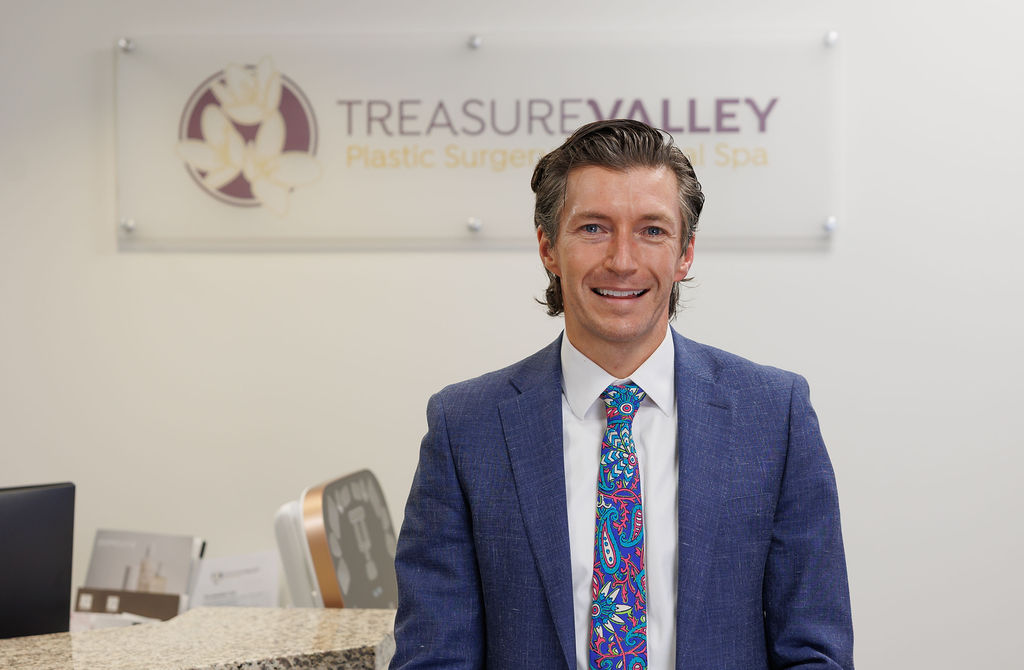
Dr. Louis Poppler, MD, MSCI
Board-Certified Plastic Surgeon · American Board of Plastic Surgery · Last reviewed October 4, 2026
Treasure Valley Plastic Surgery