Body Contouring & Natural Volume Enhancement
Body Fat Grafting in Boise & Meridian, Idaho
Move Volume From Where You Don't Want It to Where You Do
Body fat grafting, also called fat transfer, uses liposuction to remove fat from an area where you don't want it, processes that fat, and carefully places it into an area where you want more fullness. Because fat grafting uses your own tissue, it can add volume that looks and feels natural while simultaneously slimming and contouring the area where the fat was removed.
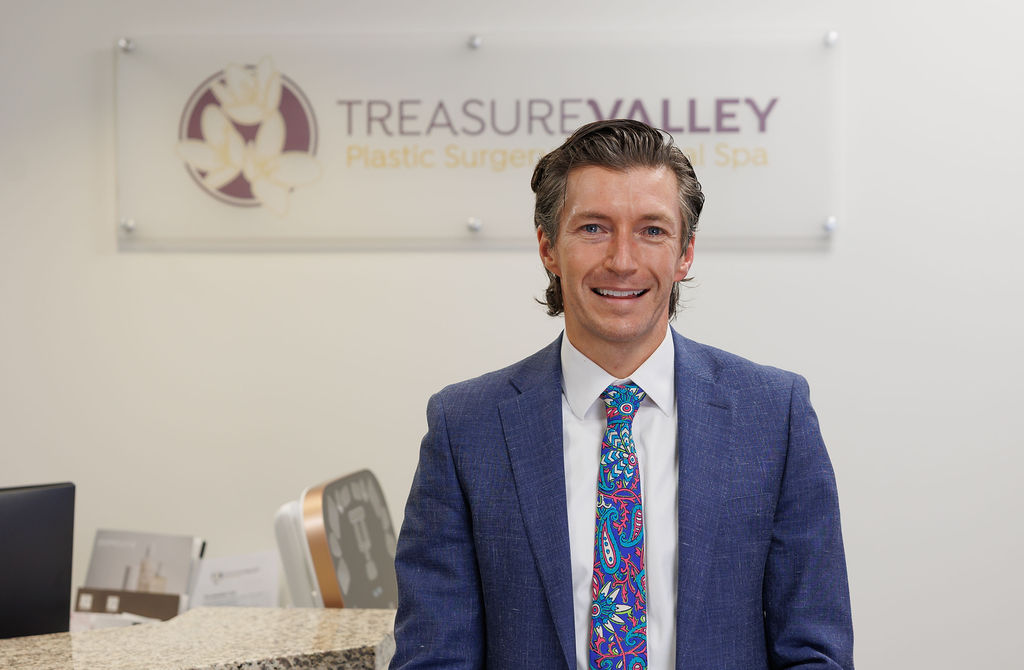
At Treasure Valley Plastic Surgery, Dr. Louis Poppler most commonly uses body fat grafting for natural breast enhancement — often in combination with liposuction, abdominoplasty, or a mommy makeover.
One Procedure. Two Complementary Goals.
Remove Fat. Refine Shape. Restore Volume.
Many patients have areas where they would like less fat and other areas where they would like more fullness. Fat grafting allows both goals to be addressed during the same operation.
Donor Area
Abdomen · Flanks · Back · Thighs
Liposuction
Fat is carefully harvested while contouring the donor area
Processing
Harvested fat is prepared for transfer
Target Area
Fat is carefully placed where additional fullness is desired
Fat Grafting Requires More Than Moving Fat
Successful body fat grafting requires two complementary surgical skills. The appearance of both the donor area and the grafted area matter — which is why choosing a plastic surgeon experienced in both liposuction and the target anatomy is important.
01
Liposuction & Body Contouring
Fat must be harvested while creating a smooth, natural contour in the donor area. Poor technique during harvest can leave the donor area uneven or irregular.
02
Precise Fat Placement
Fat must be carefully placed in small amounts throughout the tissues so that each graft can establish a blood supply and survive — creating natural-looking volume.
Dr. Louis Poppler is certified by the American Board of Plastic Surgery and has training and experience in breast surgery, liposuction, and body contouring.
The Most Common Use at Our Practice
Breast Augmentation With Fat Transfer
Fat transfer can enhance breast volume through small incisions without placing a breast implant. Because it uses the patient's own fat, breast fat transfer does not disrupt the pectoralis major muscle or the breast's natural support ligaments. The result tends to feel very natural.
Fat can be placed in specific portions of the breast — including the upper breast — to create targeted fullness and improve cleavage without adding substantial volume to areas where it is not desired. This makes fat transfer a precise tool for appropriately selected patients who want a modest, natural-feeling improvement.
Natural Volume.
No Breast Implant.
For appropriately selected patients, fat transfer can provide a modest breast-size increase while simultaneously contouring areas such as the abdomen or flanks.
Breast fat transfer is intended for modest enhancement — typically up to approximately one cup size. Patients who want a substantially larger increase, who have significant breast sagging, or who lack adequate donor fat may be better served by breast implants, a breast lift, or a combination approach. Dr. Poppler will discuss all options at consultation.
Who Is a Good Candidate for Body Fat Grafting?
Dr. Poppler evaluates each patient individually at consultation and makes a personalized recommendation. The following characteristics are generally associated with good candidacy.
May Be a Good Candidate
- Generally healthy
- Nonsmoker
- At a stable weight
- Has enough donor fat to harvest
- Wants a modest, natural-looking volume increase
- Interested in improving both a donor area and an area needing more fullness
Fat Grafting May Not Be the Best Option If:
- –The patient is very thin and lacks adequate donor fat
- –A substantially larger breast-size increase is desired
- –The breasts have significant sagging that may require mastopexy
- –Another procedure would better address the patient's goals
What If I'm Too Thin for Fat Grafting?
Fat grafting requires enough donor fat to safely harvest and transfer. Very thin patients may not have adequate available fat to achieve their goals with traditional autologous fat grafting.
Alloclae: An Option for Patients With Limited Donor Fat
Treasure Valley Plastic Surgery also offers Alloclae — fat donated by human organ donors — for appropriately selected patients who may not have enough of their own fat for grafting. Dr. Poppler will discuss whether Alloclae is a suitable option at consultation.
Fat Grafting vs. Breast Implants
There is no single right way to enhance the breasts. Fat grafting and breast implants each offer different advantages. Dr. Poppler offers both approaches and will give his recommendation based on your goals, anatomy, and lifestyle.
| Factor | Fat Grafting | Breast Implants |
|---|---|---|
| Volume | Usually up to ~1 cup size | Can provide a substantially larger size increase |
| Feel | Very natural — uses your own tissue | Depends on anatomy and implant selection |
| Implant | None | Yes |
| Future considerations | None implant-related | Implant monitoring and possible future replacement |
| Donor area | Simultaneously slims and contours | No liposuction required unless separately desired |
| Size predictability | More variable — not all fat survives | More predictable |
| Recovery | Includes liposuction recovery | Generally shorter than fat grafting recovery |
| Cost | Tends to cost more | Usually less expensive |
How Is Body Fat Grafting Performed?
Step 01
Harvesting
Fat is gently removed with liposuction from donor areas such as the abdomen, flanks, back, or thighs. This simultaneously slims and contours the donor area. Careful harvesting technique is important to preserve the viability of the fat cells.
Step 02
Processing
The harvested fat is processed to remove injured fat cells that will not survive, excess fluid, and non-fat tissues. This concentrates the healthy fat that will be transferred.
Step 03
Grafting
The prepared fat is injected in many small amounts and in multiple layers through small incisions. Placing small amounts throughout the tissues — rather than in large deposits — helps each graft establish a blood supply and survive, producing a more natural and lasting result.
How Much of the Transferred Fat Survives?
Fat survival varies from patient to patient based on surgical technique and individual biology.
General Range — Not a Guaranteed Individual Outcome
~70–80%
of fat transferred to the breast generally survives and permanently contributes volume
Fat that does not survive is gradually absorbed by the body during the first several months. During this time, swelling also resolves and the final volume becomes apparent. It can take several months for the result to fully stabilize.
Some patients choose a second fat-grafting procedure to add additional volume, improve symmetry, or refine the result. This does not indicate a problem with the first surgery — it is simply the nature of fat grafting.
Why Stable Weight Matters
Transferred fat behaves like the rest of the fat in your body. Weight changes after surgery can affect the transferred fat in the same way they affect other fat deposits.
↓
Weight Loss
Transferred fat can shrink
→
Stable Weight
Helps maintain a more stable result
↑
Weight Gain
Transferred fat can enlarge
Patients who are planning significant weight loss may be better served by reaching their intended stable weight before surgery.
Potential Benefits of Body Fat Grafting
Uses Your Own Tissue
Natural-looking and natural-feeling volume because it is made from your own fat.
Two Areas Benefit
Slims and contours the donor area while adding volume where you want more fullness.
Targeted Enhancement
Can add volume to specific portions of the treatment area rather than enlarging everything uniformly.
No Breast Implant
No future risk of breast implant leakage or need for implant replacement when used for breast enhancement.
Small Incisions
Fat grafting generally uses small, discreetly positioned incisions less than 1 cm.
One Operation
Body contouring and volume restoration can both be accomplished during the same surgical session.
Can Fat Grafting Be Combined With Other Procedures?
Body fat grafting is commonly combined with other body-contouring procedures. Combining procedures may allow fat removed during body contouring to be used strategically for volume enhancement during the same operation. Not every patient is a candidate for combined surgery — Dr. Poppler will discuss what is appropriate for you.
Liposuction
Fat harvested during liposuction can sometimes be transferred to enhance another area.
Learn moreAbdominoplasty / Tummy Tuck
Fat grafting can complement tummy tuck surgery for patients who want to add volume in another area.
Learn moreMommy Makeover
Fat grafting is commonly included in mommy makeover planning for patients who want natural breast enhancement alongside body contouring.
Learn moreBreast Procedures
Fat grafting can be used alone for modest breast enhancement or in combination with breast implants or a breast lift.
Learn moreWhere Are the Scars?
Fat grafting generally uses small incisions less than 1 cm. Dr. Poppler places incisions in natural creases, existing scars, or otherwise discreet locations whenever possible.
Donor Area Incisions
- — Abdomen
- — Sides / flanks
- — Back
- — Other harvest areas
Breast Incisions (if applicable)
- — Breast fold
- — Edge of the areola
- — Other discreet locations as appropriate
Scar Care Is Included With Surgery
All patients undergoing surgery with Dr. Poppler at Treasure Valley Plastic Surgery receive:
- Medicated silicone scar gel
- Laser treatment of surgical scars
Included as part of the surgical price.
What Type of Anesthesia Is Used for Fat Grafting?
Because fat grafting begins with liposuction, anesthesia options are similar to those used for liposuction at Treasure Valley Plastic Surgery.
In the Office
Smaller procedures may be performed with mild sedation for patient comfort.
In the Operating Room
Larger or combined procedures use deep sedation or general anesthesia.
The appropriate option depends on the amount of fat being harvested and transferred, the treatment areas, other procedures being combined, and patient comfort. Dr. Poppler will recommend the safest and most comfortable approach for your individual procedure.
Body Fat Grafting Recovery: What to Expect
Recovery after body fat grafting is similar to liposuction recovery, with additional swelling in the grafted area. Swelling generally lasts longer than after breast augmentation with an implant. Dr. Poppler provides individualized guidance regarding work, exercise, compression, bra use, and pressure on grafted areas.
First Few Days
Many patients return to light activities. Rest and limited movement are recommended during this initial period.
About 1–2 Weeks
Many patients return to desk work. Strenuous activity and exercise should still be avoided.
First Month
Compression garments are generally worn around the clock over donor areas. If breast fat grafting was performed, a supportive bra may also be required.
Following Weeks
Compression garments may continue for part of the day. Activity restrictions gradually lift as Dr. Poppler advises.
Several Months
Swelling can fluctuate while liposuction areas heal and grafted fat settles. The final volume becomes apparent over this period as fat stabilizes.
How Long Do Fat Grafting Results Last?
Once transferred fat successfully establishes itself and heals, the surviving fat is long-lasting. However, the transferred fat remains living fat and can change with weight loss, weight gain, aging, pregnancy, and genetics.
Maintaining a stable weight helps preserve the result. Individual outcomes vary.
What Are the Risks of Body Fat Grafting?
As with any surgical procedure, body fat grafting carries risks. Risk factors that can increase the likelihood of complications include smoking, poor nutrition, diabetes, autoimmune disease, and medications that affect bleeding. Discussing your full medical history with Dr. Poppler is important.
Important Note on Breast Fat Grafting: Lumps
Fat necrosis or oil cysts can sometimes develop after breast fat grafting. These are areas of fat that did not survive and can create firm lumps. They are generally benign, but any new breast lump should be evaluated by a physician. Depending on the clinical situation, additional evaluation — such as mammogram, ultrasound, or biopsy — may be appropriate.
Is Body Fat Grafting Safe?
Body fat grafting is generally safe when performed on appropriately selected patients by a board-certified plastic surgeon. Choosing an experienced surgeon, modifying risk factors before surgery, and carefully following aftercare instructions all help reduce the likelihood of complications. At Treasure Valley Plastic Surgery, your safety is our number one priority.
To verify a plastic surgeon's board certification, you can use the American Board of Plastic Surgery's surgeon finder at find.plasticsurgery.org.
Additional Peace of Mind
Treasure Valley Plastic Surgery includes a complication plan in its surgical pricing that can help pay for care related to a complication.
Treasure Valley Plastic Surgery is a cash-pay practice and does not bill health insurance.
What Happens If I Need Additional Fat Grafting or Revision?
Because fat survival varies, some patients may choose or require additional fat grafting to add more volume, improve symmetry, or address a contour irregularity. This is not necessarily an indication that the first procedure was unsuccessful — it is part of the nature of fat grafting.
Dr. Poppler follows patients after surgery and discusses any concerns about healing or results openly and honestly.
What Does Body Fat Grafting Cost in Boise, Idaho?
The cost of body fat grafting depends on the amount of fat harvested and transferred, the donor areas, treatment areas, anesthesia, and whether procedures are combined. Fat transfer using the patient's own fat tends to cost more than breast augmentation with a breast implant.
Dr. Poppler provides personalized pricing at consultation. To schedule a consultation, call (208) 753-2400.
Fat Transfer Near Boise, Idaho
Treasure Valley Plastic Surgery is located in Meridian, Idaho and serves patients from Boise, Meridian, Eagle, Nampa, Caldwell, Canyon County, and throughout the Treasure Valley.
At consultation, Dr. Poppler evaluates areas where you would like less volume, areas where you would like more, donor fat availability, skin quality, breast and body anatomy, lifestyle, previous surgery, medical history, and aesthetic goals. He can then discuss whether fat grafting, breast implants, or another procedure is most appropriate.
Treasure Valley Plastic Surgery
3277 E. Louise Drive, Suite 375
Meridian, Idaho 83642
(208) 753-2400Frequently Asked Questions
Ready to Begin
Could the Fat You Don't Want Create the Volume You Do?
Body fat grafting can address two goals during the same operation: contouring areas with unwanted fat and using that tissue to create natural volume elsewhere. A consultation with Dr. Poppler is an opportunity to evaluate your donor areas, anatomy, and desired result and compare fat grafting with options such as breast implants, Preservé, or other body-contouring procedures.
Treasure Valley Plastic Surgery · 3277 E. Louise Drive, Suite 375 · Meridian, Idaho 83642 · (208) 753-2400
Serving Boise, Meridian, Eagle, Nampa, Caldwell, Canyon County and the greater Treasure Valley.
Content reviewed by Dr. Louis Poppler, MD, MSCI · Board Certified Plastic Surgeon · Last reviewed October 2026