Facial Plastic Surgery
Neck Lift in Boise
& Meridian, Idaho
Restore Definition to the Neck & Jawline
A neck lift is a surgical procedure designed to create a smoother, more youthful and better-defined appearance of the neck and jawline. For both women and men, neck lift surgery can address loose skin, diminished jawline definition, excess fullness beneath the chin and other visible signs of aging in the neck.
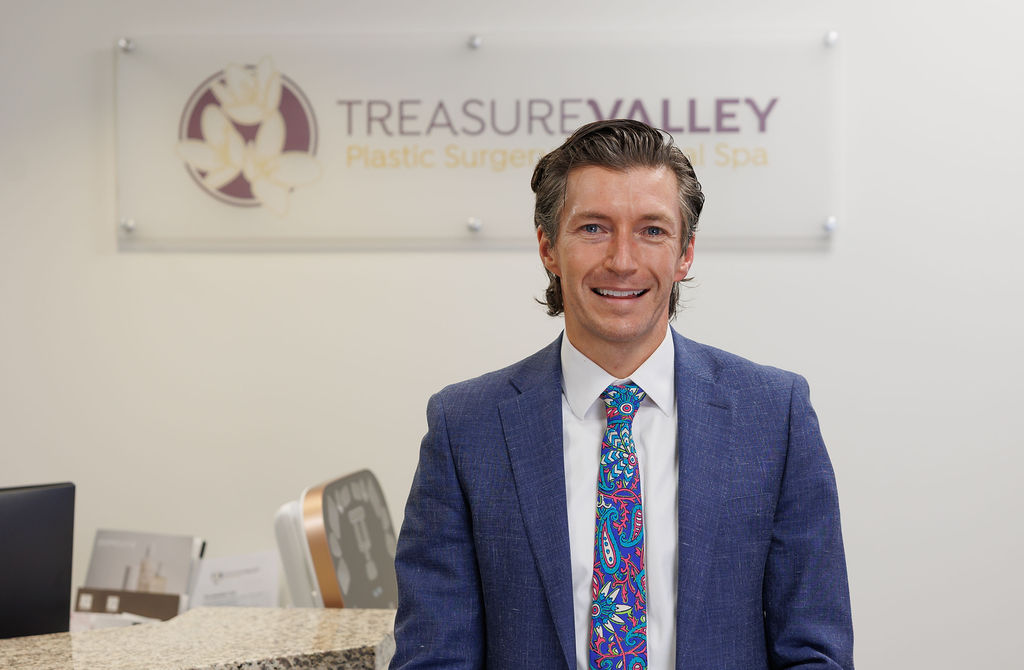
At Treasure Valley Plastic Surgery, Dr. Louis Poppler provides individualized neck lift surgery for patients from Boise, Meridian, Eagle, Nampa, Caldwell and throughout the greater Treasure Valley, with an emphasis on natural-looking results and discreetly placed incisions.
Procedure
Neck Lift
Surgeon
Dr. Louis Poppler
Anesthesia
General
Setting
Outpatient
Social Recovery
~2 Weeks
Usual Activities
~4 Weeks
Full Recovery
~3 Months
Location
Meridian, ID
Recovery varies by patient and surgical plan.
What Is a Neck Lift?
A neck lift is a surgical procedure designed to create a smoother, more youthful and better-defined contour of the neck and jawline. The goal of a well-performed neck lift is to restore the cervicomental angle — the distinct angle that defines the border between the neck and the jaw. A youthful neck has a clearly visible, pleasing angle in this area. With age, that angle is lost as fat accumulates, muscles loosen, and skin becomes lax.
A neck lift can also improve mild-to-moderate jowling — the visible descent of tissue along the lower jaw that blurs the once-sharp jawline.
"A youthful neck is defined not simply by tighter skin, but by the relationship among the jawline, underlying muscles, fat, deeper structures and skin."
As we age, several changes occur simultaneously in the face and neck. The facial bones shrink slightly, reducing the structural scaffolding that once held soft tissues in place. The fat of the face and neck changes — some areas lose volume while others accumulate excess. Connective tissue stretches and loosens its hold on deeper structures. Skin undergoes its own changes: fine lines, wrinkles, laxity and pigmentation. All of these contribute to the loss of neck and jaw definition, the fullness beneath the chin, the visible platysmal bands, and the loose skin that many patients seek to address with a neck lift.
Dr. Poppler emphasizes that the best results from any facial rejuvenation procedure come from evaluating all of these components together rather than addressing only one in isolation.
Why Consider Neck Lift Surgery?
Neck lift surgery works on more than skin alone. It is technically demanding and must be individualized to each patient's anatomy. When performed comprehensively, it can address a range of anatomical concerns.
Sharper Neck-Jaw Angle
Restore the cervicomental angle that defines the border between the jaw and neck.
Improved Jawline Definition
Reduce blurring of the jawline caused by jowling and soft-tissue descent.
Reduced Fullness Beneath the Chin
Address excess fat and muscle fullness in the submental region.
Correction of Platysmal Neck Bands
Tighten or address the platysma muscle to reduce visible vertical neck bands.
Removal of Excess Skin
Carefully remove and redrape loose, redundant skin for a smoother contour.
Improvement of Deep Skin Folds & Wrinkles
Reduce the appearance of deep horizontal and vertical lines in the neck.
Because every patient's anatomy is different, Dr. Poppler does not use a single standardized technique. The surgical plan is determined by a detailed evaluation of your anatomy, your concerns, and your goals.
Neck Lift vs. Facelift: What's the Difference?
Neck lift and facelift surgery are frequently performed together, but not every patient needs both. The two procedures address overlapping but distinct anatomical regions.
Neck Lift
Primarily addresses:
- Neck fullness beneath the chin
- Cervicomental angle (neck-jaw border)
- Loose neck skin
- Platysmal neck bands
- Upper-neck and jawline contour
- Mild-to-moderate jowling
Facelift
Primarily addresses:
- Sagging cheeks and midface descent
- Heavy nasolabial folds
- Lower-face soft tissue descent
- Significant jowling
- Marionette lines
- Overall facial shape and contour
Some patients benefit from a neck lift without the additional expense, recovery and risk of a facelift. Others have anatomical changes in the lower face — deep nasolabial folds, prominent jowls, marionette lines — that a neck lift alone would not adequately address, and a combined approach is recommended.
At your consultation, Dr. Poppler will evaluate your anatomy, concerns and photographs with you and recommend a surgical plan based on your individual priorities. He will not recommend performing a neck lift or facelift alone if he believes doing so would produce a suboptimal result.
Understanding the Platysma & SMAS
The platysma is a broad, flat muscle that spans the front of the neck. It is part of a connected tissue system called the SMAS — the Superficial Muscular Aponeurotic System. The SMAS is an important layer of tissue in the face and neck composed of the muscles of facial expression and their supportive tissues. You can think of the SMAS as the "support layer" that helps maintain the shape of the face and neck.
As we age, the platysma and SMAS stretch and loosen. This allows the overlying fat and skin to descend, and the edges of the platysma to separate, creating the visible vertical bands that run along the front of the neck. Addressing the platysma is central to most comprehensive neck lifts.
What Is a Deep Plane Neck Lift?
The "deep plane" refers to a tissue plane beneath the SMAS. In the neck, this means working beneath the platysma. You may hear the term "deep plane neck lift" used — but it is worth understanding that essentially all comprehensive surgical neck lifts that address the platysma involve work beneath this muscle.
"Deep plane" is a more diagnostically meaningful term in facelift surgery, where distinguishing between procedures that work above, within, or below the SMAS has significant implications for outcomes. In the neck, the more informative question is not whether the surgery is "deep plane" but what specific anatomical structures the surgeon plans to address.
A Better Question to Ask Your Surgeon
"What components of my neck will you address — and why?"
What Makes a Good Neck Lift?
Dr. Poppler evaluates five important anatomical components when planning neck lift surgery. Not every patient needs every component addressed, but a comprehensive neck lift surgeon should be prepared to address each when appropriate.
Excess Fat
Excess fat beneath the skin and beneath the chin may be removed when appropriate. The amount and location of fat removal is individualized based on each patient's anatomy.
Digastric Muscles
The digastric muscles beneath the chin may be tightened or reduced when necessary. These paired muscles can contribute to fullness beneath the chin even after fat removal.
Submandibular Glands
Prominent or descended submandibular glands may require resuspension or reduction in selected patients. This is a more advanced component that not all neck lift surgeons address.
Platysma
The platysma muscle is repositioned and tightened to improve neck contour and the cervicomental angle. This is a central component of most comprehensive neck lifts.
Excess Skin
Excess skin is carefully removed and redraped to create a smoother, more defined contour. Incisions are placed behind the ears and in the posterior hairline, with a small incision beneath the chin.
Not every patient requires all five components. The important distinction is carefully evaluating each component and creating a surgical plan based on the patient's individual anatomy. The incision beneath the chin provides access to the deeper neck structures, while incisions positioned behind the ears and along the posterior hairline allow for skin redraping and removal.
An Individualized Approach to Neck Lift Surgery
Dr. Poppler's background includes extensive training in facial cosmetic surgery, nerve surgery and hand surgery — disciplines that share an emphasis on working carefully within delicate anatomy and understanding the relationship between structure and function. This foundation informs his approach to neck lift surgery.
Dr. Poppler takes time during each consultation to understand your history, concerns, goals and fears. He carefully examines your anatomy and reviews photographs from different angles to develop an individualized surgical plan rather than applying a standardized technique.
Photographs from Younger Ages
Patients may be asked to bring photographs of themselves at younger ages. These photographs help Dr. Poppler understand the patient's natural youthful anatomy and develop a plan intended to restore their own features rather than create an artificial or "done" appearance. The goal is never to make you look like someone else — it's to help you look like the best version of yourself.
Dr. Poppler is certified by the American Board of Plastic Surgery and performs neck lift surgery at an accredited surgical facility in Meridian, Idaho, serving patients from Boise, Eagle, Nampa, Caldwell and throughout the Treasure Valley.
Dr. Louis Poppler, MD, MSCI
Certified by the American Board of Plastic Surgery
Are There Different Types of Neck Lifts?
The term "neck lift" encompasses a range of techniques, from isolated liposuction of the neck to comprehensive procedures that address all five anatomical components described above. Depending on the patient's anatomy and goals, a neck lift may include platysma tightening (platysmaplasty), skin redraping and removal, fat removal or liposuction, submandibular gland reduction, and digastric muscle contouring.
Not every patient needs every procedure. A patient whose primary concern is isolated fat beneath the chin may be well served by neck liposuction alone. A patient with loose skin, platysmal bands, and submandibular gland prominence will require a more comprehensive approach.
When consulting with a surgeon, ask which structures they plan to address, which they do not plan to address, and why.
Are There Alternatives to Neck Lift Surgery?
A neck lift is the most comprehensive surgical option for addressing the neck and jawline. Selected patients with less advanced concerns may benefit from less invasive approaches — either as an alternative to surgery or as a complement to it.
Neck Liposuction
Treasure Valley Plastic Surgery
For selected patients whose primary concern is excess fat beneath the chin or jaw, neck liposuction alone may be an appropriate option.
Chin Augmentation
Treasure Valley Plastic Surgery
A chin implant, fat transfer or filler can improve facial proportions in patients with a small chin or underbite, often improving the apparent definition of the neck-jaw angle.
Neuromodulators (Botox)
Treasure Valley Medical Spa
Botox or other neuromodulators may soften visible platysmal bands in selected patients with mild concerns. Results are temporary and require maintenance.
Learn MoreBiostimulators & Fillers
Treasure Valley Medical Spa
Radiesse and Juvederm may be options for selected concerns involving skin quality, contour, or volume in the lower face and jawline.
Learn MoreHALO TRIBRID Laser
Treasure Valley Medical Spa
HALO TRIBRID laser resurfacing can improve skin color, texture and visible skin quality in the face and neck. It does not address structural anatomical causes of neck aging.
Learn MoreSkinTyte
Treasure Valley Medical Spa
Broadband light-based SkinTyte treatments may improve mild-to-moderate skin laxity in the neck. An option for patients who are not ready for or interested in surgery.
Learn MoreNeck Lift vs. FaceTite, Morpheus8 & Ultherapy
Nonsurgical skin-tightening technologies such as FaceTite, Morpheus8 and Ultherapy are sometimes marketed as alternatives to neck lift surgery. These technologies can create meaningful improvement in mild skin laxity, and selected patients may be appropriate candidates. However, they do not address all of the anatomical causes of neck aging.
Treasure Valley Medical Spa offers SkinTyte — a broadband light-based treatment that may improve mild-to-moderate skin laxity — for appropriate nonsurgical candidates. Treasure Valley Medical Spa does not currently offer FaceTite, Morpheus8 or Ultherapy.
Nonsurgical Treatments May Address
- Mild skin laxity
- Skin texture and tone (laser resurfacing)
Surgical Neck Lift Can Address
- Excess skin
- Excess fat
- Platysmal banding
- Submandibular gland prominence or descent
- Deeper structural laxity
Where Are Neck Lift Incisions & Scars?
Incisions for neck lift surgery are carefully positioned to minimize their visibility. The primary incisions are placed behind the ears and extend along the posterior hairline. A small incision beneath the chin — in the natural crease — provides access to the deeper structures of the neck.
After healing, these incisions typically become less conspicuous. The incisions behind the ears are naturally concealed, and the submental incision falls in a location that is difficult to detect once healed.
Your Surgical Price Includes
- Silicone scar gel
- Complimentary laser scar treatment after surgery
Treasure Valley Plastic Surgery includes these scar-care measures as part of your surgical experience to help optimize the appearance of your incisions as they heal.
Learn About Scar TreatmentsNeck Lift Recovery: What to Expect
Recovery from neck lift surgery is gradual and individualized. The following timeline represents a general guide; your actual recovery will depend on your anatomy, the extent of your procedure, and your body's response to surgery.
Day of Surgery
Outpatient surgery performed under general anesthesia. Patients go home the same day. Short walks are encouraged beginning the day of surgery.
Days 1–2
The face and neck remain supported with a soft postoperative wrap. Rest and limited activity are expected. A friend or family member should be available to assist.
Day 2 or 3
Office visit for dressing change and removal of the hemostatic net. Dr. Poppler or his team will check on your incisions and overall recovery.
Day 5 or 6
Return visit for incision suture removal. At this point, most patients are moving more comfortably and swelling is beginning to visibly improve.
First Week
Temporary neck tightness and mild difficulty swallowing can occur and generally improve as swelling decreases and tissues settle.
Around 2 Weeks
Bruising has generally improved substantially. Many patients feel comfortable leaving home, attending light social activities, or running errands.
Around 4 Weeks
Patients are typically returning to their usual activities, including most forms of exercise. Dr. Poppler will advise on specific activity restrictions.
Up to 3 Months
Mild swelling and firmness may continue to improve gradually. Full recovery takes approximately three months, with final results becoming more apparent over this time.
Recovery varies from patient to patient. Dr. Poppler will provide individualized postoperative instructions.
Frequently Asked Questions
Risks & Possible Complications
Neck lift surgery is a carefully planned surgical procedure, and Dr. Poppler takes extensive measures to minimize risk. As with any surgery, complications are possible and patients should be fully informed before proceeding.
Common temporary effects include swelling, bruising, neck tightness and temporary numbness in the skin of the neck and lower face as nerves heal. Temporary difficulty swallowing is also common in the first week and typically resolves as swelling improves.
Less common but more significant complications include infection, hematoma (blood collecting beneath the skin), sialoma (fluid collection related to salivary tissue), and temporary changes in facial movement. Revision surgery is occasionally necessary to address asymmetry or refine results.
Following your surgeon's postoperative instructions — including keeping the head elevated, avoiding strenuous activity, and attending all follow-up appointments — helps minimize the risk of complications.
Additional Peace of Mind
Treasure Valley Plastic Surgery's surgical fee includes a complication insurance plan through CosmetAssure that may help with eligible expenses related to treatment of a complication.
Treasure Valley Plastic Surgery is a cash-pay practice and does not bill health insurance.
An optional revision surgery plan is also available to help cover eligible costs associated with revision surgery.
Written & Reviewed by Dr. Louis Poppler, MD, MSCI
Certified by the American Board of Plastic Surgery · Last Reviewed October 4, 2026
Treasure Valley Plastic Surgery
Is a Neck Lift Right for You?
Every face and neck ages differently. A consultation with Dr. Poppler is an opportunity to discuss what bothers you, evaluate the anatomical changes contributing to those concerns, and determine whether a neck lift, facelift, combination procedure or less invasive treatment best aligns with your goals.
3277 E. Louise Drive, Suite 375 · Meridian, Idaho 83642
Serving Boise, Meridian, Eagle, Nampa, Caldwell and the greater Treasure Valley.
Related Procedures